You pay your credit card on time every month but your credit score is still not moving. Sound familiar? In most cases, the reason is credit utilization — and once you understand how it works, it is one of the fastest things you can fix.
<cite index="22-1">Credit utilization accounts for 30% of your FICO score — the second biggest factor after payment history.</cite> Unlike payment history, which builds slowly over years, utilization can change your score within a single billing cycle. That makes it the fastest lever you have direct control over.
Here is exactly what it is, how to calculate it, and what percentage you should actually be aiming for.
What Is Credit Utilization Ratio?
Credit utilization ratio is the percentage of your available credit limit that you are currently using across your credit cards.
Simple version: if your credit card has a $1,000 limit and you have a $300 balance, your utilization is 30%.
Credit bureaus look at utilization in two ways simultaneously:
- Per-card utilization — how much you are using on each individual card
- Overall utilization — your total balances across all cards divided by your total credit limits
Both matter. A card that is maxed out hurts your score even if your overall utilization looks fine. <cite index="26-1">Even a $200 balance on a card with a $300 limit — 66% utilization — can negatively impact your FICO score.</cite>
How to Calculate Yours
The formula is straightforward:
Utilization % = (Total balance ÷ Total credit limit) × 100
Example:
- Card 1: $500 balance, $2,000 limit
- Card 2: $300 balance, $3,000 limit
- Total balance: $800 | Total limit: $5,000
- Overall utilization: 16%
Check each card individually too. Card 1 above sits at 25% per-card utilization — within range but worth watching. If Card 1's balance rose to $700, that single card would be at 35% and pulling your score down even though your overall figure looks fine.
What Percentage Should You Aim For?
Here is the honest breakdown by score goal:
<cite index="24-1">People with exceptional credit scores of 800–850 have an average credit utilization of just over 7%.</cite> That is the real target — not 30%.
The 30% figure gets repeated everywhere as a rule, but it is more accurately described as the upper limit before real damage begins. Your goal should be single digits if you want the highest possible score.
Why 30% Is a Ceiling — Not a Target
This is the most misunderstood part of credit utilization. <cite index="23-1">FICO scoring treats utilization as a continuous variable — your score improves steadily as the ratio falls. Someone reporting 8% will almost always outscore someone reporting 28%, all else equal.</cite>
Think of 30% the same way you would think of a speed limit. Staying under it keeps you out of trouble. But nobody drives at the speed limit and calls it optimal — you aim lower for safety and control.
Aim for under 10% on each card and overall. Under 30% is acceptable. Over 30% is where the score damage begins to compound.
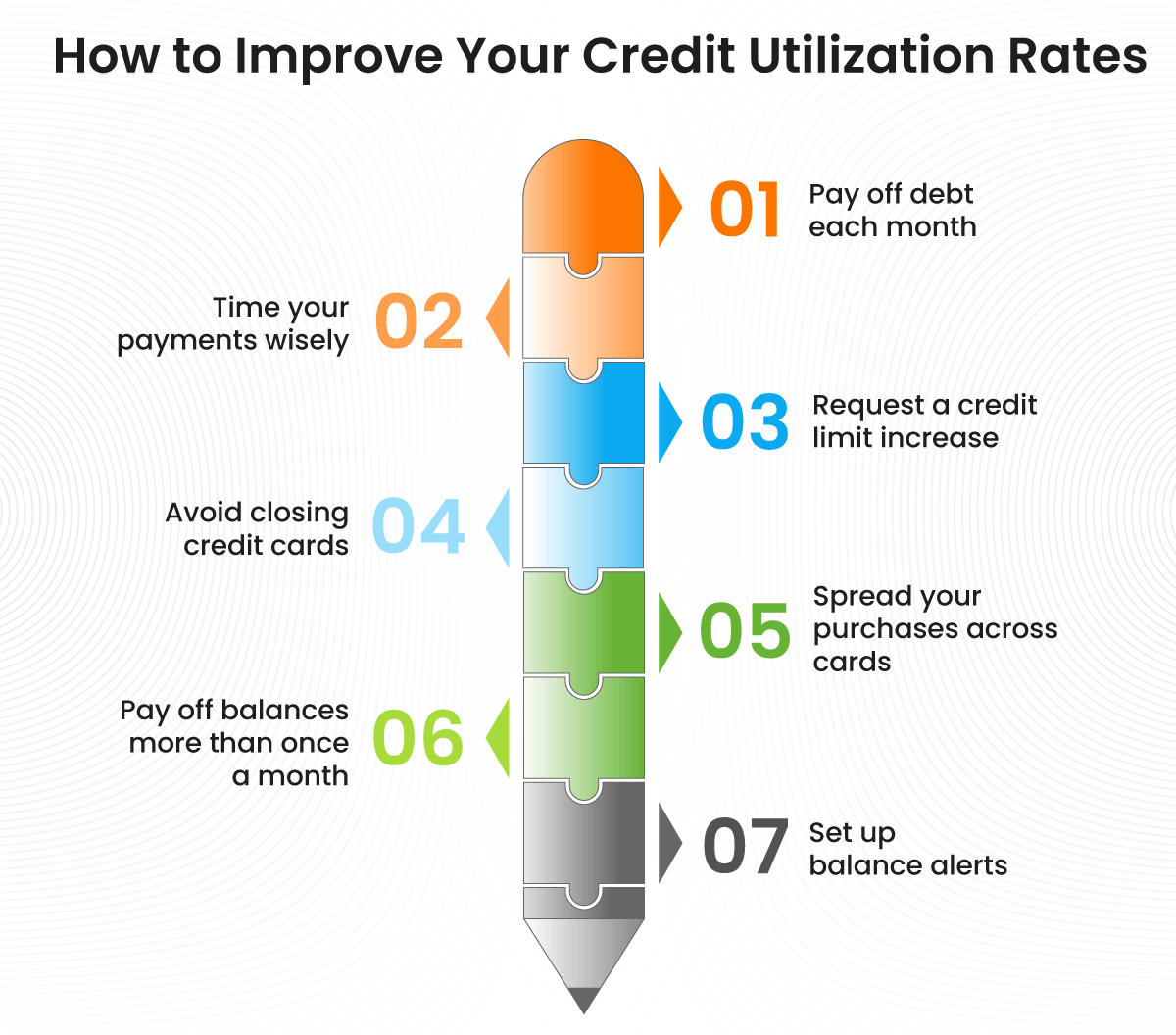
5 Ways to Lower Your Utilization Fast
1. Pay your balance before your statement closes — not just before the due date.
This is the single most effective tactic most people do not know. Your credit card reports your balance to the bureaus on your statement closing date — not your payment due date. If you carry a $700 balance and pay it on the due date, the bureaus already saw that $700. Pay it down before the statement closes and the bureaus see a $50 balance instead.
<cite index="22-1">Unlike payment history, which takes years to build, lowering utilization can boost your score in just 30–60 days.</cite> Pay before your statement closes and you will see the improvement in the following month's score update.
2. Make a mid-cycle payment.
If you have already spent close to your limit, make a second payment mid-month to bring the balance down before the statement date. You are not paying twice — you are just timing one payment earlier.
3. Ask for a credit limit increase.
If your limit goes up and your balance stays the same, your utilization drops automatically. Most issuers allow a limit increase request online with no hard inquiry after 6–12 months of on-time payments. A $1,000 limit rising to $2,000 halves your utilization overnight on that card.
4. Do not close old credit cards.
Closing a card removes its credit limit from your total available credit, which pushes your overall utilization up. If you have an old card you no longer use, leave it open with a small recurring charge — a streaming subscription works — on autopay. Its unused limit keeps your utilization low.
5. Spread spending across cards.
If you have two cards and put everything on one, that card's per-card utilization climbs even if the other sits empty. Spreading spending across two cards keeps both individual figures lower and protects your per-card score.
The Bottom Line
Credit utilization is 30% of your FICO score and the fastest factor you can improve without waiting months or years. Keep every card under 30% at minimum — but aim for under 10% if you want an exceptional score. Pay before your statement closes, not just before the due date. Never close old cards. And if your limit can go up, ask — it costs nothing and reduces your utilization immediately.
For a full picture of where your score stands right now, read our guide: What is a good credit score in the US?
Sources:
Written by
Harshal Chaklasiya
Editorial contributor at Blynter. Passionate about personal finance, investing, budgeting, and creating practical money guides that help readers make smarter financial decisions.